












On View at MFAH: Of Light and Air: Winslow Homer, from the Museum of Fine Arts, Boston

The exhibition, Of Light and Air: Winslow Homer from the Museum of Fine Arts, Boston, is on view at the MFAH from November 1, 2026, through February 7, 2027.
The MFAH is the only travel venue for the show, which was organized by and debuted at the MFA Boston in fall 2025.
Of Light and Air presents nearly 50 watercolors by the artist, alongside a selection of his oils, drawings, and prints. With material ranging from watercolor over graphite on paper, childhood drawings to his final canvas, the exhibition follows the major chapters in his career and explores the various environments—ecological, artistic, social, and economic—that shaped his enduring work in watercolor. Homer’s watercolors capture the look and feel of a place, transporting us to the rugged Maine coast, New York’s Adirondack Mountains, the English seashore and the sunlit Caribbean.
“We are thrilled that our colleagues in Boston have consented to share with us their definitive collection of works by Winslow Homer,” commented Gary Tinterow, director and Margaret Alkek Williams chair of the MFAH. “The Museum of Fine Arts, Boston is not only one of the world’s premier art museums, but the longtime steward of the singular legacy ofWinslow Homer. As a quintessential New England artist, Homer—much like his exact contemporary Mark Twain—captured life in America as it transformed from an agrarian economy to an industrial powerhouse. Because Homer’s light-sensitive works on paper are normally kept in dark storage, this exhibition provides a once-in-a generation opportunity to see Homer’s vision of our country, made visible only in Houston on the occasion of the nation’s semiquincentennial.”
“This exhibition invites visitors to explore how Homer grew as a watercolor artist—and to see for themselves why he’s considered the greatest American watercolorist of the 19th century. His dazzling works burst with color and showcase techniques that were bold, inventive, and ahead of their time,” said Dr. Kaylin H. Weber, The Lora Jean Kilroy Curator of American Painting and Sculpture.
Exhibition Overview
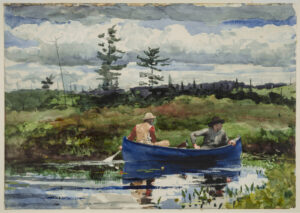
The exhibition is largely organized chronologically, following the major chapters of Homer’s life. The first gallery opens with some of Homer’s most iconic watercolors, including the The Blue Boat (1892), and introduces the range of techniques and approaches he developed over the course of nearly 40 years. Highlights in this section include Leaping Trout (1889), the first watercolor by Homer to enter the MFA Boston’s collection and the first to be purchased by any museum.
The following section, “Origins,” explores Homer’s early years in Boston and his work as a freelance illustrator for print houses and publications including Ballou’s Pictorial Drawing Room Companion and Harper’s Weekly, along with works from when he served as a “special artist” on the front lines of the Civil War. These include rare examples of Homer’s eyewitness observations: ink wash drawings that introduced him to the possibilities of watercolor. The 1870s marked a pivotal shift in both Homer’s life and the cultural landscape of the
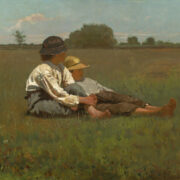
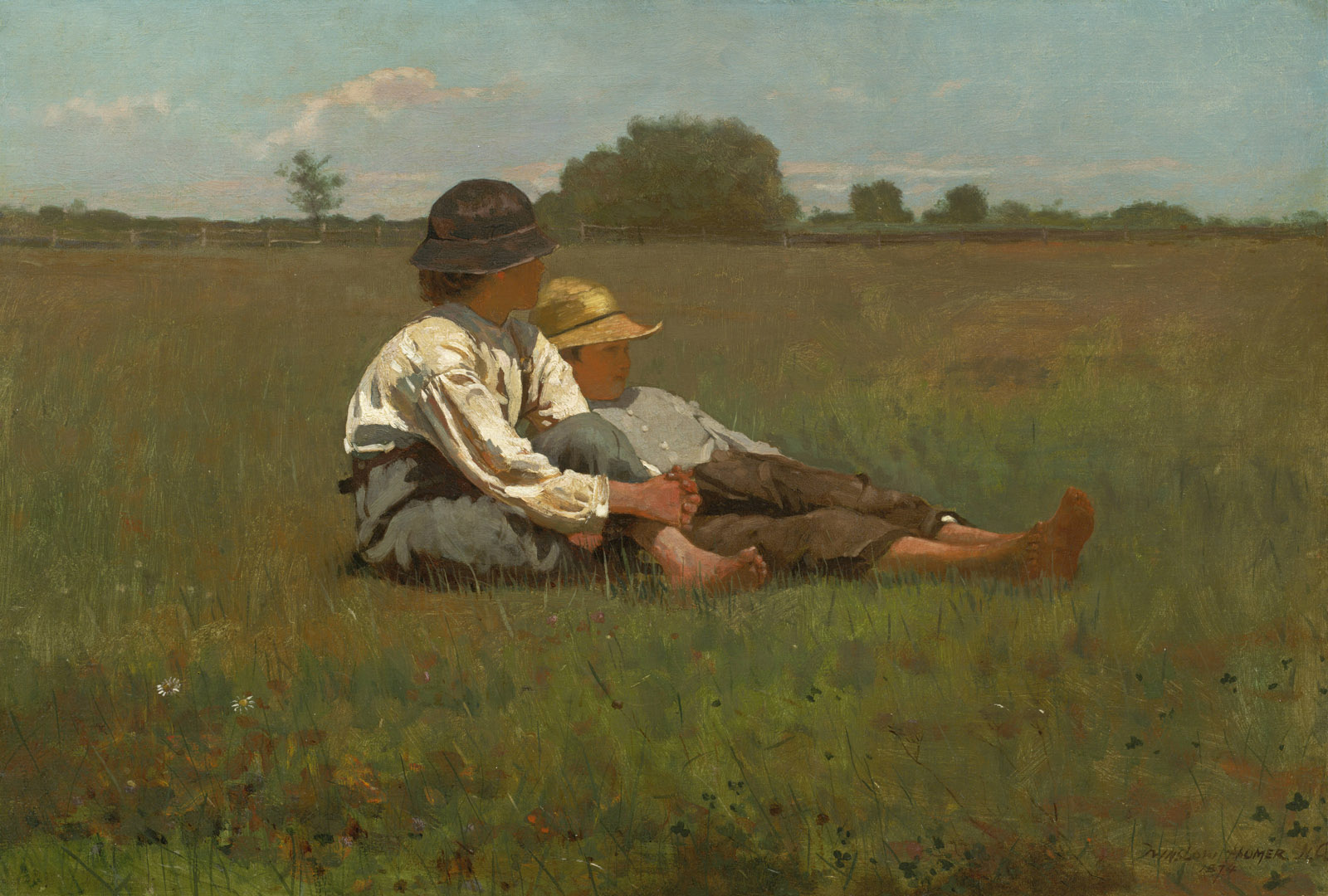
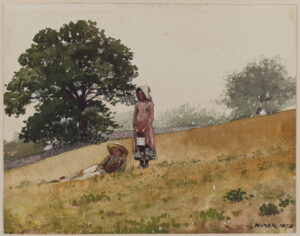
U.S. The section “Transitions” highlights the artist’s early forays into watercolor and show how he moved between watercolor and oil, often revisiting the same subjects in both mediums, such as the rural lives of children, New York’s rolling Hudson Valley, and popular new leisure spaces like the beach. In this period, Homer’s work offered solace to a nation recovering from the Civil War and he increasingly depicted women and children in works such as Boys in a Pasture (1874).Throughout his career, Homer was drawn to the sea. “Atlantic Shores” looks at the watercolors painted between 1873 and 1904 in coastal communities from Gloucester, Massachusetts, to Prouts Neck, Maine, as well as in Florida, the Caribbean and England. As Homer refined his practice, he increasingly differentiated his oils from his watercolors—laboring over large paintings but painting watercolors quickly, favoring observation and experimentation over narrative content.







Beginning in the early 1870s, Homer spent extended periods in the Adirondacks in upstate New York, later joining the North Woods Club, a private organization that preserved land for fishing and hunting. “The North Woods” presents some of Homer’s most innovative watercolors, trading ocean vistas for enveloping forest scenery.
In the video “Winslow Homer: A Legacy in Watercolor,” visitors can enjoy a video featuring Judith Walsh, paper conservator and Professor Emerita, SUNY Buffalo State College, and James Prosek, artist, writer, and naturalist, who share insights on Homer’s life and influence. The two take a closer look at some of Homer’s watercolors in the MFA Boston’s Morse Study Room and venture to Homer’s home and studio in Prouts Neck. Prosek also paints a watercolor, employing many of Homer’s techniques.
Homer’s studio was located directly on the coast, and he spent many hours during the last decades of his life observing and recording the movement of waves and the varied colors of ocean and sky. “Turn, Turn, Tumble,” the final gallery in the exhibition, takes its name from a phrase Homer wrote on the wall of his Prouts Driftwood, 1909, oil on canvas, Henry H. and Zoe Oliver Sherman Fund and other funds, the Museum of Fine Arts, Boston.

Neck Studio, articulating the motion of rolling waves, a phenomenon he frequently strove to capture. It includes two depictions of waves painted 23 years apart—Breaking Wave (Prouts Neck) (1887) and Driftwood (1909), Homer’s final oil painting.
About the Artist
Winslow Homer was born in Boston and raised in Cambridge, Massachusetts. Around the age of 17, he began an apprenticeship at one of Boston’s leading print shops, where he learned about composition and draftsmanship. Though he later relocated to New York and then to Maine, Homer maintained his ties to Boston through the patrons, dealers, printers, and publishers who supported him throughout his career. Working as a freelance artist, Homer contributed illustrations to popular newspapers. At the start of the Civil War in 1861, Harper’s Weekly sent him to the front lines as an artist-correspondent. Homer was embedded with a regiment of Union troops for six weeks, where he sketched scenes of military action and life in camp.Homer painted some of his first oils and began experimenting with watercolor after the war. He enjoyed increasing success as an oil painter, regularly exhibiting and selling his work to collectors in Boston and New York. In the 1870s, watercolor became a critical part of his art practice. As he honed his technique, Homer traveled widely to the Hudson Valley, the Adirondacks, Massachusetts, Maine, Florida, the Caribbean, England, and Canada—drawing inspiration from the landscapes and communities he encountered. From 1884 until his death in 1910, he lived and worked in his Prouts Neck studio in Maine.
About the Museum of Fine Arts, Houston
Spanning 14 acres in the heart of Houston’s Museum District, the MFAH main campus comprises the Audrey Jones Beck Building, the Caroline Wiess Law Building, the Lillie and Hugh Roy Cullen Sculpture Garden and the Nancy and Rich Kinder Building. Nearby, two house museums—Bayou Bend Collection and Gardens, and Rienzi—present collections of American and European decorative arts. The MFAH is also home to the Glassell School of Art, with its Core Residency Program and Junior and Studio schools; and the International Center for the Arts of the Americas (ICAA), a leading research institute for 20th-century Latin American and Latino art. www.mfah.org