





















Does Memory Have a Color?

 My great-grandparents’ generation passed along many studio photographs typical of their time. To have their photo taken, everyone would dress up in their Sunday best for the professional photo session. The result was often a sepia-toned photograph.
I must admit that until recently, I wasn’t aware of the reason for the abundance of these brown photographs. It seems the reason was not purely aesthetic. Early photographic papers weren’t very stable, and sepia toning added a protective layer that improved the longevity and durability of photographs. The fact that so many of these photographs still exist, nearly 100 years later, is proof that this toning process was successful.
The advent of gelatin silver paper in the 1870s provided greater stability for prints, reducing the need for toners. However, all toning processes, including sepia toning, enhance the tonal properties and longevity of photographic prints, regardless of the paper used. As standard practice, I tone all of my black-and-white prints with selenium, gold, or sepia toning solutions. In some cases, I’ve obtained interesting and dramatic results by combining (or layering) these toning processes.
Nowadays, you can take a photo with your phone, convert it to black-and-white, and apply a sepia filter in a matter of moments, but I still enjoy the tried-and-true (and just a little bit stinky) analog process.
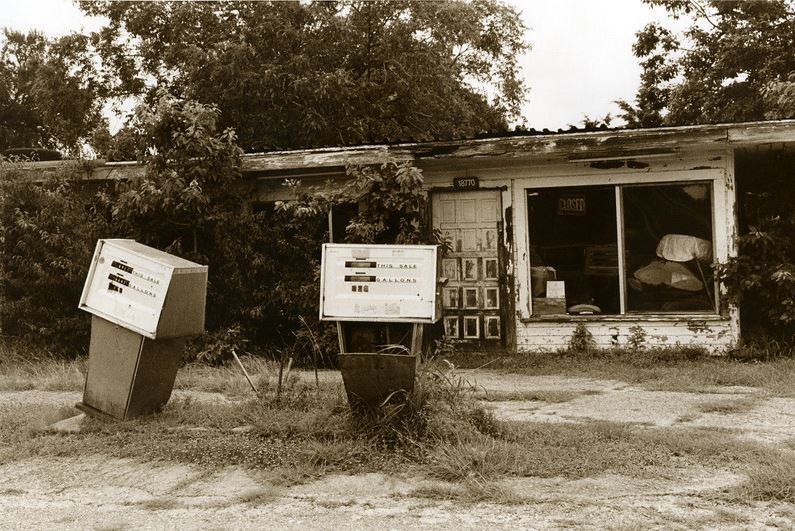
“Rest Stop” hangs in my studio. Sometimes I wonder if it’s a view into the future or a memory of the past. Several of my literary friends have written poems about where this print takes them. Where does it take you?

 melodylocke.smugmug.com
melodylockeart@gmail.com