





















Liquid Gold in the Peloponnese: An Olive Oil Story

One of my favorite memories of the Greek Peloponnese was an old woman wobbling to our rent car and handing us a basket of fruit. She wasn’t selling. She was following the custom of offering food and drink to strangers, a tradition so ancient it’s narrated in Homer. Ancient Greeks considered hospitality to strangers a sacred obligation. In part because they believed the gods disguised themselves as mortals. To blow off properly greeting strangers who might be gods in disguise was not only impious but incautious. As stupid as short changing the gods during sacrifice. When I returned to Greece I experienced further hospitality to strangers, markedly in small villages, in the form of cups of tea or small glasses of ouzo, handed over simply to sweeten a greeting. It’s worth noting I had similar experiences in small villages across Turkey, when I traveled from the western to the eastern borders. Another favorite memory of my time in the Peloponnese was seeing olive groves so abundant and beautiful they made me cry.
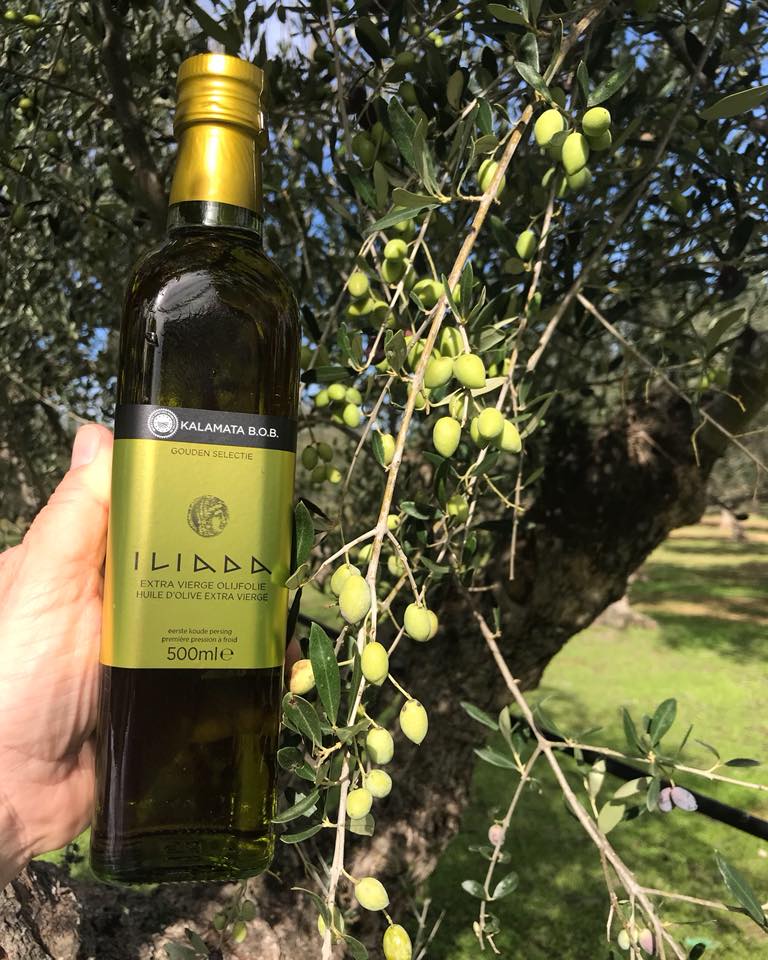
Here’s my point. Recently, I found my Tanqueray bottle alarmingly low and the wine stash dwindling, so I rushed to Spec’s Liquor downtown and purchased a bottle of gin, eleven bottles of wine, Roquefort cheese and some mixed nuts. As I rolled my goodies toward the cashier, a bottle of olive oil stopped me in my tracks. Iliada Olive Oil is manufactured in the Peloponnese.
I’ll admit that in Spec’s I was sucked in by gimmicky marketing devices. The olive oil’s name riffs off Homer, and its label sports the image of a Homeric type mythological hero. Once home however, it became clear I’d purchased a respectable olive oil. Iliada, also sold at Phoenicia Foods, is designated “Kalamata PDO,” meaning, Protected Designation of Origin, which guarantees an extra virgin olive oil produced within a defined geographical area of the Kalamata region, according to specific rules and standards. Put simply, olives hand picked in November and December are pressed within 24 hours at cool temperatures because the “cold extraction” method produces the purest and best oil, and in some ways, mirrors the ancient Greeks’ stone press process.
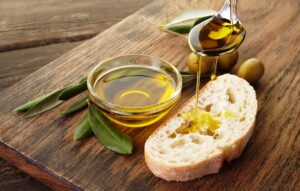
Nothing could be more sorry than to taste a decent olive oil without a loaf of freshly baked crusty bread. So after unloading booze from the Jeep I hightailed it to the bakery at Central Market to buy a loaf. Back home, I poured olive oil over a slice and added a tiny pinch of salt and dried oregano. At that moment I understood why Homer called olive oil “liquid gold.”
The liquid gold inspired me to make a Greek salad topped with feta cheese. Greeks call these salads “horiatiki” or “village salad.” Their ingredients vary slightly by location. It must be said that in Crete I ate village salads with mezythra (mizithra) cheese, from sheep or goat milk, not feta, from cow milk, but if you use feta, be sure to cut large chunks. Still giddy with inspiration, the next day I made spinach pastries. While brushing liquid gold over the thin sheets of dough that wrapped my mixture of spinach, onion, garlic, mint and cheese, I remembered Donnie and I taking a narrow winding road to a mountain side taverna in central Crete, where surrounded by a mouth dropping view and greedy taverna cats we downed cold beer and ate spinach pies.
It’s painful going to Spec’s without my Donnie. We always went there together. He pushed the shopping cart and chose all our wines. Donnie began sending me messages a couple of days after he died, from, I’m convinced, a state of pure consciousness. He said he’s always with me. It’s important to seek joy.
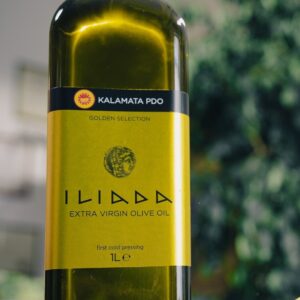
I dug a little deeper into Iliada. Iliada’s Kalamata olives are specifically the Koroneiki variety from groves on the slopes of the Taygetus mountains near Kalamata in the Messenian region of the southern Peloponnese. This region has some of the oldest olive groves in mainland Greece. People there have a strong sense of the past butting up against the present with respect to olive oil, because nearby are the ruins of a Bronze Age Mycenaean palace complex known as the Palace of Nestor at ancient Pylos that was home to people whose lives were closely tied to olive oil. Olive oil pervaded food, cleanliness, illumination, medicine, rituals (big time,) taxation and more. Archaeologists dug up storage pantries and storage amphorae and transport jars along with a variety of other artifacts relevant to olive oil. Equally important, they discovered clay tablets inscribed with palace administrative records written in an ancient Greek language called Linear B that documented the kingdom’s manufacture, storage and trade of olive oil.

Glancing at the findings, Mycenaean Pylos was sitting pretty. It had frescoes in the throne room, elaborate banquet ware, and gold objects found in burials, probably fueled by olive oil, metal goods and maritime trade. Interaction with Egypt and the Near East presented opportunities. Don’t discount war plunder. But for all its prosperity, there may have been signs of disaster. Why else would there be human sacrifices, although scholars disagree on this. Needless to say, the gods were as fickle as they were sexually indiscriminate. Acts of propitiation recorded on the tablets turned out to be useless. In the end someone wiped the floor with the kingdom. By approximately 1200 BC Pylos was burned to the ground.
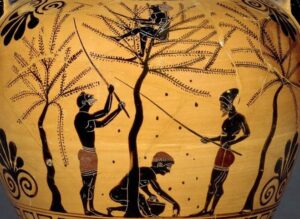
Before the Mycenaean civilization (c.1600-1150 BC) could live high on the hog in part from olive oil, olive cultivation had to enter Greece. Which it did by way of Crete. Here’s the big picture. Roughly 6000 years ago Neolithic folks elsewhere in the Mediterranean figured out it was smarter to farm olives than hassle with wild ones, precisely the kind of thing you’re supposed to figure out in the “Neolithic.” Domestication spread. By 2000 BC the Minoan civilization on Crete was cultivating olives and manufacturing olive oil. Minoan practices spread from Crete to mainland Greece, where the Mycenaean culture took it up. Objects unearthed at another Mycenaean center in the Peloponnese, the kingdom of Mycenae with the infamous Lions Gate, described by Homer as “Mycenae rich in gold,” bear this out. By the way, Athenians claim the goddess Athena gave them the olive tree. Well and good. But olive cultivation irrefutably came from Crete. Manufacturers in the Peloponnese call olive oil “a 6000 year old treasure.”
A short distance south of Kalamata in the Mani region at the very bottom of the Peloponnese is a place that has intrigued me for years. In Greece it’s not unusual to trip over mystical sites, environments with porous boundaries between the physical and invisible worlds. I’ve seen some. Cape Matapan, also called Cape Tainaron, is the mythological entrance to the Underworld, where the god of the dead Hades lives. In antiquity there was an oracle. Other temples on the site bit the dust, but ruins of a Temple to Poseidon, with a Christian church plopped on top still exist. Those who visit can meditate or ingest potent “stuff” or use other practices to achieve an altered state of consciousness, and perhaps be healed or have an out of body experience, or talk to the gods, or talk to the dead. I haven’t been, but intend to go. I want to talk to the dead.