





















Saved too much in a 529? Consider a Roth IRA rollover



Asst. Vice President
Frost Bank
If you’ve been investing in a 529 account, you already know it’s a powerful, tax-advantaged tool to fund education. But oversaving is a concern for families who plan ahead, since withdrawals not used for qualified expenses are subject to income taxes and a 10% penalty on earnings. If you’ve built up more than your child needs, a 529-to-Roth IRA rollover can help those dollars continue working toward the future.
Why oversaving happens
With the rising cost of college, overfunding a 529 may seem unlikely, but there are many ways this can happen. Strong investment growth, a child choosing a lower-cost school or receiving a generous scholarship, or deciding against a four-year degree could leave you with thousands of unused funds. The good news? Excess 529 savings don’t have to go unused – there’s now a way to turn them into a lasting financial advantage.
A retirement boost for the next generation
The SECURE 2.0 Act of 2022 introduced new flexibility: allowing certain unused funds to be rolled over—tax free and penalty free—into a Roth IRA account established for the same beneficiary. If you’re sure you won’t have other educational expenses to cover, converting 529 funds to a Roth can give your child a head start on building a retirement nest egg.
Guardrails to understand
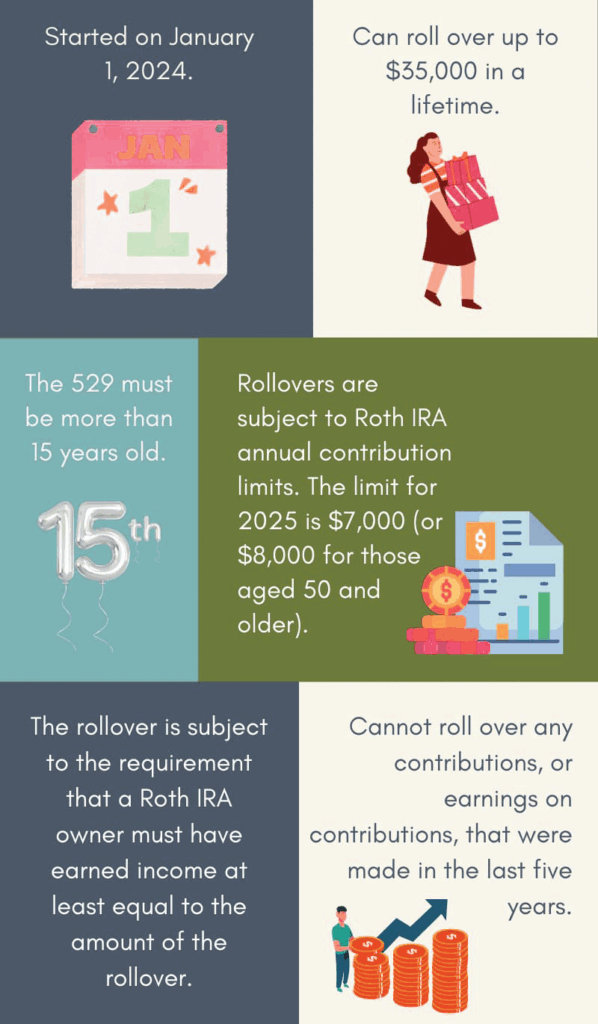
To qualify for a rollover, the 529 account must be at least 15 years old, and the rollover must come from contributions made at least five years prior. The amount transferred each year cannot exceed the beneficiary’s annual Roth IRA contribution limit ($7,500 in 2026 for those under 50), and they must have an equal amount of earned income in that year—so you may need to conduct the rollover in phases. Finally, 529-to-Roth rollovers are capped at a lifetime maximum of $35,000.
Other strategic options
If your remaining balance exceeds the $35K rollover cap, or if other family members could benefit from the funds, you can change the account beneficiary. Also remember that 529s aren’t just for college; they can also help pay for trade school, private school or K-12 expenses for younger children or future grandkids. Following the passage of the One Big Beautiful Bill Act (OBBBA), these plans have become even more flexible to include non-tuition costs like instructional materials and dual-enrollment fees.
With the right guidance, a 529 plan can evolve alongside your family’s goals – from education to retirement and beyond. Reach out to Michael Johnson at 713.388.7812 or Michael.Johnson@frostbank.com to ensure your education savings plans continue to support your long-term wealth strategy.

Frost Bank and its affiliates do not provide tax or legal advice. For guidance tailored to your personal circumstances, please consult a qualified, independent tax or legal advisor. Investment management services and trust services are offered through Frost Wealth Advisors of Frost Bank. Investment and insurance products are not FDIC insured, are not bank guaranteed, and may lose value. Brokerage services offered through Frost Brokerage Services, Inc., Member FINRA/SIPC, and investment advisory services offered through Frost Investment Services, LLC, a registered investment adviser. Both companies are subsidiaries of Frost Bank. Additionally, insurance products are offered through Frost Insurance.
Deposit and loan products are offered through Frost Bank, Member FDIC.