





















A Closer Look at “Portrait Bust of a Priestess” in the Museum of Fine Arts, Houston’s Exhibition “Imperial Rome” by Virginia Billeaud Anderson

A Closer Look at “Portrait Bust of a Priestess” in the Museum of Fine Arts, Houston’s Exhibition “Imperial Rome” by Virginia Billeaud Anderson

A Closer Look at “Portrait Bust of a Priestess” in the Museum of Fine Arts, Houston’s Exhibition “Imperial Rome” by Virginia Billeaud Anderson
A Closer Look at “Portrait Bust of a Priestess” in the Museum of Fine Arts, Houston’s Exhibition “Imperial Rome” by Virginia Billeaud Anderson
Recently, Intown recommended the Museum of Fine Arts, Houston’s exhibition “Art and Life in Imperial Rome: Trajan and His Times.” MFAH has on display approximately 160 Roman antiquities borrowed from important Italian museums, many never before seen in the U.S. You’re running out of time to see these treasures from Imperial Rome. The show ends January 25, 2026.
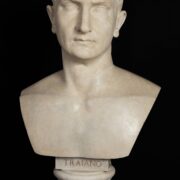
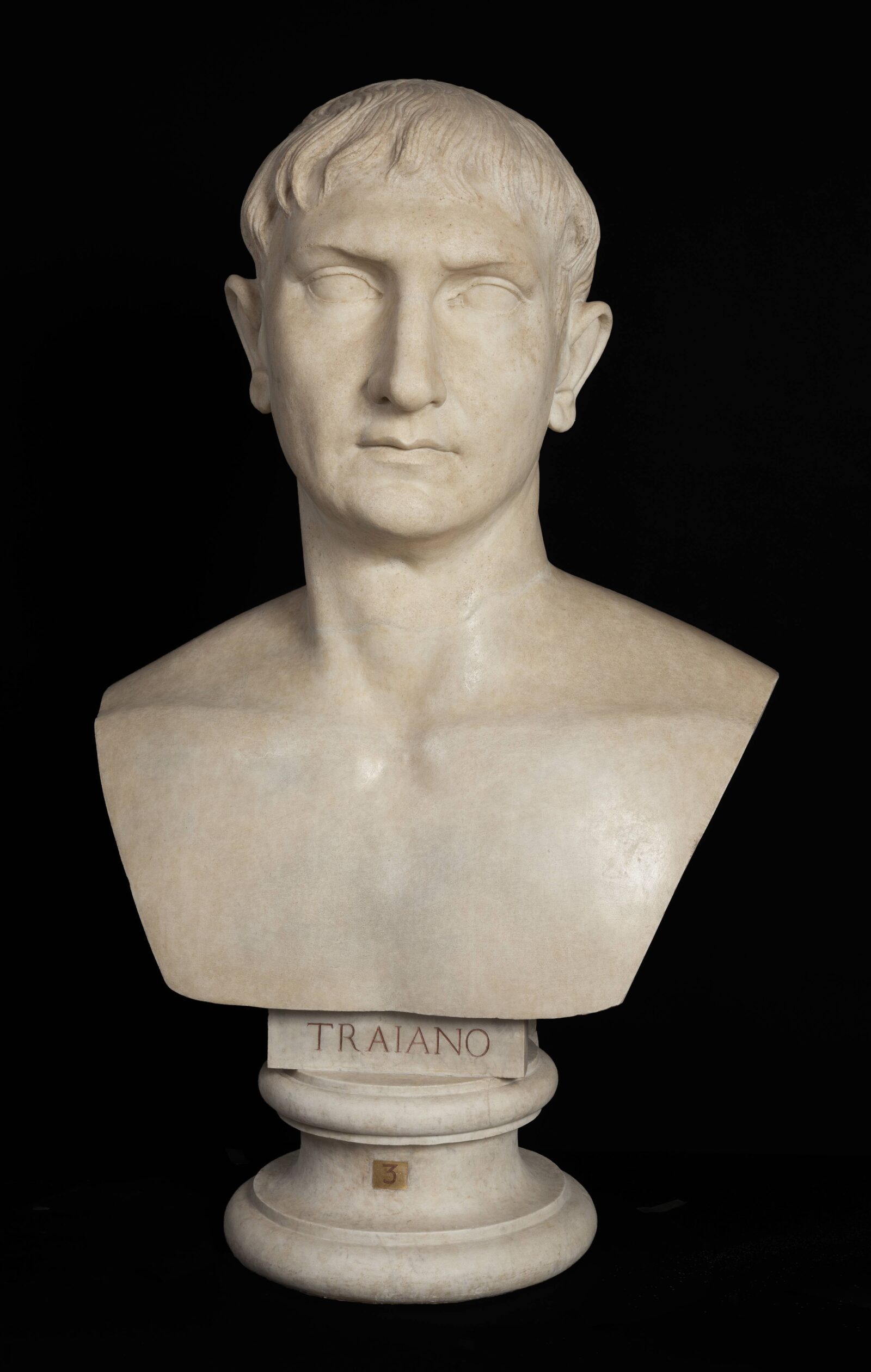
In many you’ll detect state propaganda. “Colossal Bust of Emperor Trajan” carved out of Carrara marble and loaned by the Vatican Museum illustrates my point. Dating to just after Trajan’s death in AD 117, it sat ceremoniously at Portus where Trajan built a commercial center and and artificial harbor. The gigantic bust reinforced to citizens of Portus their emperor gifted impressive public works, in the same manner a triumphal statue of Trajan on horseback near his Baths, Forum and Market messaged to citizens of Rome the emperor’s greatness. Generally speaking, objects such as this portrait bust, backed up by imperial architecture, propagandized the empire’s glory and preeminence, the military’s undefeatability, and the emperor’s divinity.
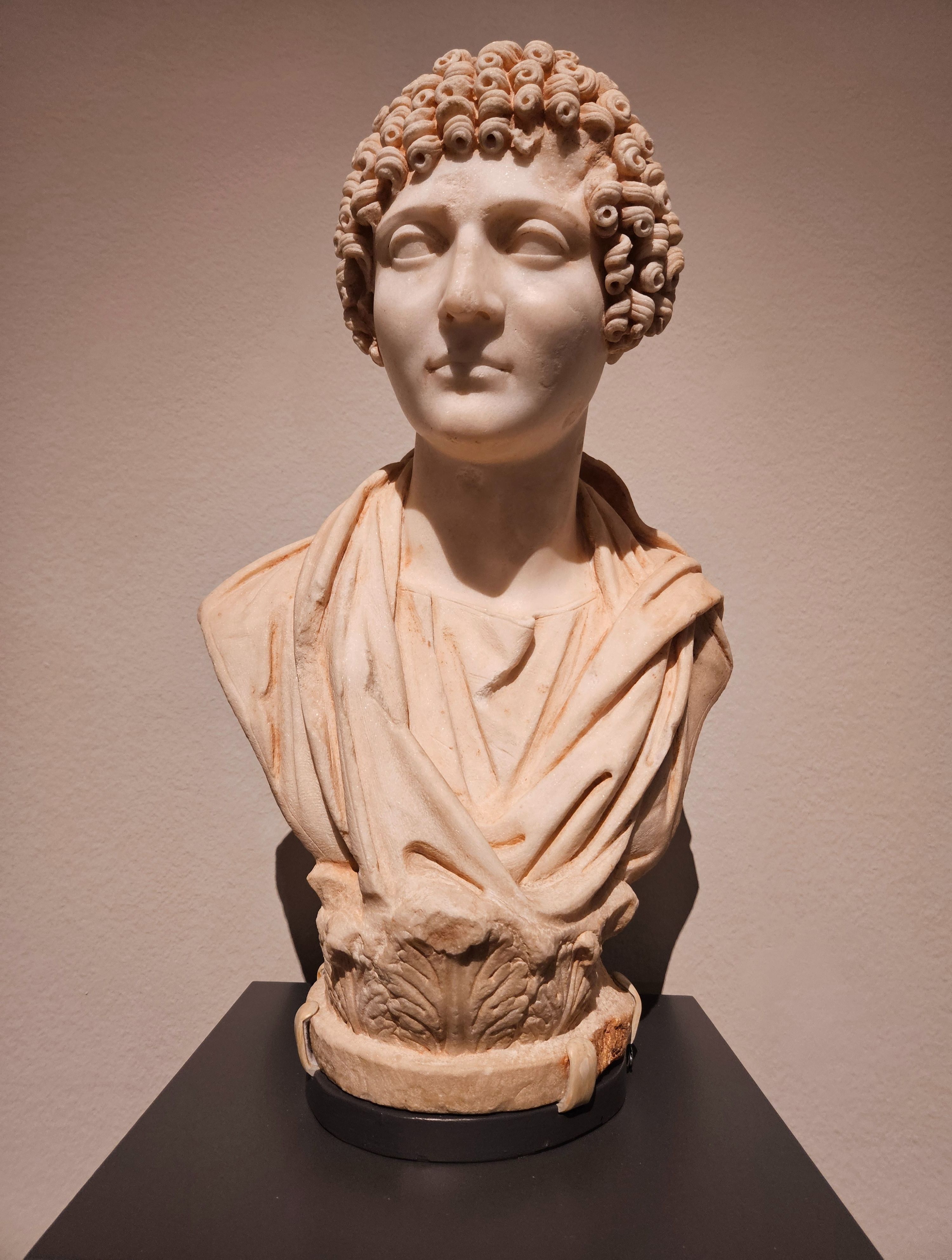
That said, I’ll turn to the reason for this article. To discuss the exhibition’s first century marble “Portrait Bust of a Priestess,” because in my opinion it’s so damned interesting. The priestess’s name is unknown, but ancient writers tell us the job of a priestess was to conduct temple rituals, offer sacrifices, maintain the altars to the gods, and serve as intermediary between the living and divine.
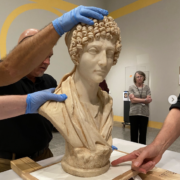
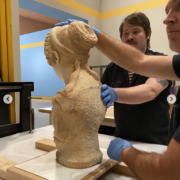
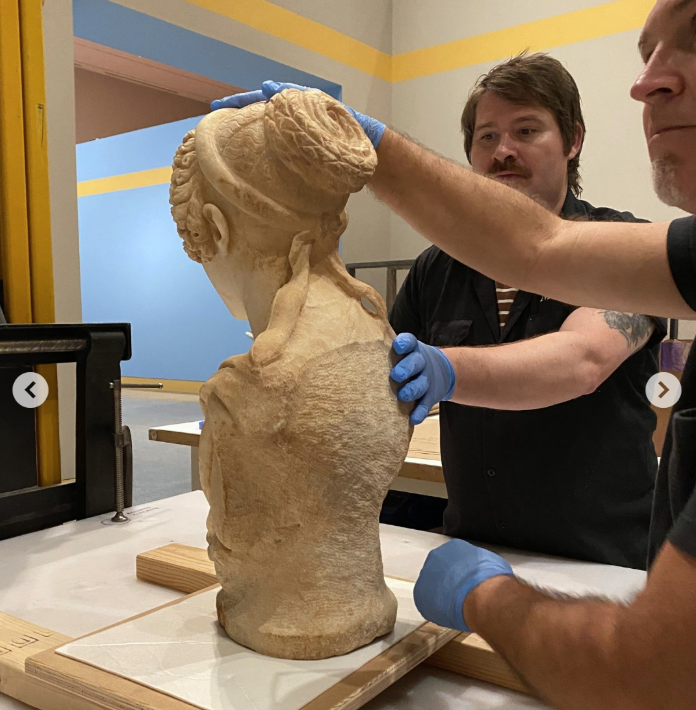
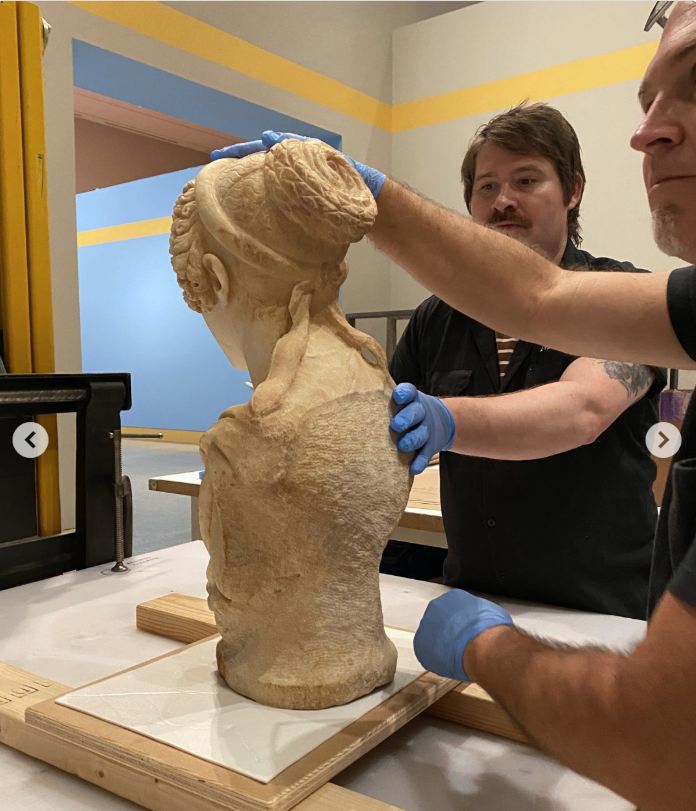
The bust was probably commissioned as a funerary portrait. Carved from Parian marble, it’s rough and unfinished back suggests it was meant to sit in a niche or against the wall.
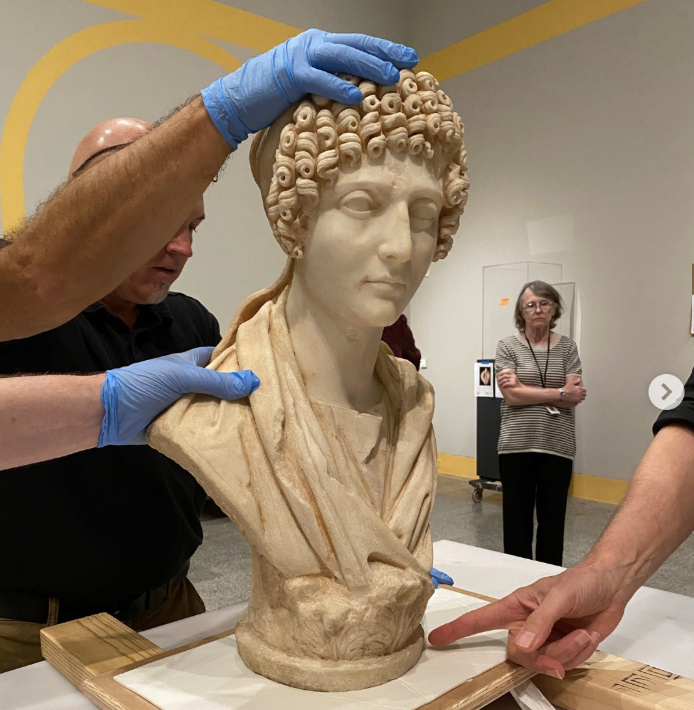
MFAH borrowed the priestess from the Carlos Museum at Emory University, so I checked out their collection notes to learn more about her. Her fashionable tunic and mantle signal she’s from “elite Roman society.” Her hair style with exaggerated curls at the front and tight braids wrapped into a bun was worn by women in Emperor Trajan’s family.
Her hair band identifies her as a priestess. She wears a thick rolled fillet or “strophion” tied in an elaborate knot at the nape of her neck. According to the Carlos Museum, the knot at her neck, known as a Hercules knot, “may suggest an association with the cult of Demeter and Persephone at Eleusis in Greece.”
If the priestess was indeed associated with the cult of Demeter and Persephone at Eleusis in Greece, she performed certain duties related to the secret ritual practices called “mysteries” at the Sanctuary of Eleusis. Eleusinian rites commemorated the myth that the god Hades abducted goddess Demeter’s daughter Persephone to be his wife in the underworld. Enraged and grief-stricken, Demeter brought agriculture to a screeching halt and humans starved. Hades agreed to release Persephone each spring, for a span of months. Vegetation regenerated during the months Persephone was free. On one level the myth tells of agriculture and on another of descent and return, and death and rebirth, voicing the goddess’s eternal aspect.
Eleusis was one of the ancient world’s most significant cult centers. It attracted visitors from across the Greek speaking world. Heavyweights like Pythagoras, Plato, Aeschylus and Sophocles went there. The Romans loved Eleusis. Augustus, Hadrian and Marcus Aurelius were among the Roman emperors initiated there. After Rome conquered Greece, the empire carried out frequent restorations and expansions of the sanctuary, such as adding temples.
After going to Eleusis, the Roman stateman Cicero concluded the secret rites eliminate fear of death. Transcending death was key. Initiates were put through experiences that shattered their egos and produced altered states. They fasted and drank the barley drink kykeon possibly spiked with mind-altering stuff. They entered terrifying dark spaces, one such may have been the sanctuary’s Cave of Hades, then were blinded by torch light. It’s believed they saw ritualistic pageants that dramatized Persephone’s captivity and Demeter’s response, and as crazy as it sounds, included ritual sex between a priestess and the sanctuary priest. “Marriage bed” rituals evocative of regeneration and fertility were not uncommon in the ancient world, in fact priestesses of the Mesopotamian goddesses Inanna and Ishtar performed ritual sex. Devotees of these goddesses wouldn’t have been freaked out over worshipful sex because they considered the natural world including sex sacred. Even if sex wasn’t included, the cumulative effects of the rites at Eleusis brought on visionary experiences of the dead and the gods. Through epiphanies of immortality, initiates transcended death.

I’m drawn to this priestess because she played an existentially significant role in assisting initiates. Ancient descriptions suggest the rites culminated with the sanctuary priest revealing “sacred objects” to initiates. Whatever these objects were, the priestess carried the chest that contained them in the ritual procession from Athens to Eleusis. It’s possible she mixed the barley drink for tripping, and handled a sacrificial piglet.
The Carlos museum didn’t say definitively the woman depicted in the portrait bust worked at Eleusis. There were other mystery cults in the Roman empire that had their source in Eleusis. The Roman grain goddess Ceres is an example. Ceres is an incarnation of Demeter. It’s possible this priestess served one of the empire’s other mystery cults.
To put this in perspective, in Crete I saw a Minoan fresco image of a priestess dated 1500 BC. She wore the same hair band with the same knot at her neck. That priestess served a goddess that embodied cosmic energy and rebirth. Many of you have seen this goddess in statuette form holding snakes or poppies. Mycenaean domination of Crete transferred the goddess tradition to the Greek mainland, where she eventually incarnated as Demeter. After visiting Egypt the writer Plutarch who “got” the continuity said Isis and Demeter were two versions of the same goddess.
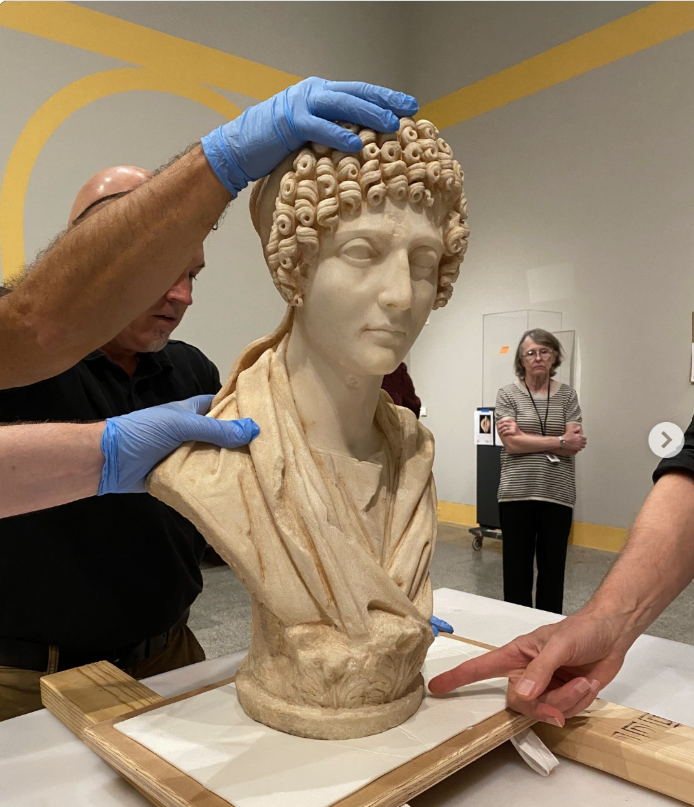
One thing is certain. The Carlos museum was really excited about their priestess coming to Houston. They posted images of the portrait bust being prepared for transport on social media. I included these for you, and I also included the image I took of the priestess when we previewed her exhibition at the end of October, although my image is pathetic, particularly the coloring. The image I included of the “Colossal Bust of Emperor Trajan” provided by MFAH on the other hand is stunning.